

More US States Are Promoting Balcony Solar
Balcony solar is a concept that began in Germany. It works like this. If you live in an apartment building with a balcony, there is a railing on the outside designed to keep people from falling off into the street below. That’s a good thing, but it also means those railings are usually quite robust.
Some clever person said, what if we took solar panels, hung them on that railing, and plugged them into a wall outlet? That way, people could generate some of their own electricity and lower their utility bills. What a brilliant idea!
People are not going to meet all their electrical energy needs that way, but they can generate some of their own electricity, which opens the door to the democratization of our energy supply — an important break from the traditional model in which every electron is purchased from a central utility on a pay-as-you-go basis.
There are perfectly valid reasons why utility companies may not embrace the idea of balcony solar. First and foremost, if there is a grid outage, some of that electricity could feed back into the grid and endanger the line crews making repairs in the field. But to a larger extent, utility companies are just not comfortable with people making their own electricity because it represents a threat to the entire business model that has served the industry well for over a century.
Balcony Solar Makes Perfect Sense
People wouldn’t do balcony solar if it didn’t make economic sense. The electricity generated by those panels can supply enough energy to power refrigerators, dishwashers, washing machines, as well as televisions and Wi-Fi routers, and all for free. The savings on utility bills can pay for the balcony solar systems usually within two to three years. Best of all, if the owner moves to a different apartment, the system can be easily removed and set up quickly in the new location.
Earlier this year, Utah became the first state in the US to pass legislation allowing people to purchase balcony solar equipment. In other states, there are laws on the books that make balcony solar illegal, but according to The Guardian that is about to change. Bills have been introduced in the legislatures in New York and Pennsylvania that would allow people to add balcony solar to their homes. Vermont, Maryland, and New Hampshire are expected to follow soon as well.
“Plug-in solar is a powerful tool to deliver enhanced energy independence and affordability to millions of New Yorkers who are currently shut out of the solar economy,” said Liz Krueger, a New York state senator who has sponsored a bill to allow balcony solar. She said her tweak to state law will be “a game changer for renters, low-income New Yorkers, and many others who can’t install rooftop solar.”
According to Kevin Chou, executive director of Bright Saver, a nonprofit that champions the adoption of balcony solar panels, “There’s now so much interest in this. The federal administration has been so negative to clean energy that people have thought ‘OK what can we do at the state level?’ and this has been one of those things. There’s real momentum behind this now. In states where electricity is more expensive, in particular, I think we will see market forces really carry this far.
“If you’re a single person living at home, it can power all of your needs, but not for a family of six. This isn’t a silver bullet or anything, it could maybe knock 5 percent off emissions. But it is an easy thing to do, it’s convenient and it can save people money. At the moment, there aren’t many wins happening for the climate and this can be one,” Chou added.
How Balcony Solar Works
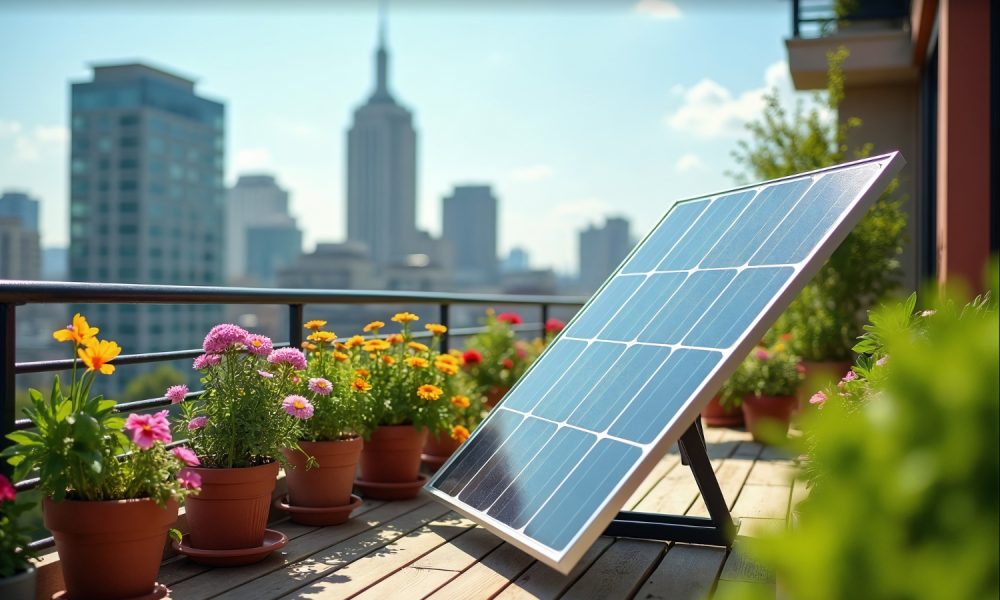
How does balcony solar work? A basic system starts with one or two solar panels. Some people attach them to their balcony railing with zip ties but often the panels have specially designed brackets on the back that fit over the railing.
Solar panels make direct current (DC) electricity. Before it gets plugged into a wall outlet, it has to be converted to alternating current (AC). That’s what inverters do, which is why all balcony solar systems come with one or more panels and an inverter. Attach the panels, connect the inverter, plug into a wall outlet, and you’re done.
How much electricity your system generates will depend on a number of factors. The most important consideration is which way the balcony faces. If it is oriented toward the south, the system will produce the most electricity. East and west facing systems will make less, and if your balcony points toward the north, you may want to consider moving.
The system only works when the sun is shining, of course. Most people are away from home during the day, so some of that electricity from the balcony mounted panels will be wasted, unless you add a small storage battery.
Residential storage batteries from Tesla and other companies are too big and too expensive to work with balcony solar, but there are lots of smaller portable battery systems that could soak up some of the electricity during the day and feed it back into the home during the night time hours. Bluetti is one such company that has been featured here at CleanTechnica on several occasions, but there are others such as Anker and DJI.
A Conversation With Cora Stryker
Cora Stryker is the co-founder of Bright Saver. In a recent conversation with Dave Roberts on his Volts podcast, she explained how the idea got started in Germany in 2019 when the government made small home solar systems legal. But it didn’t really take off until 2022, when Germany passed legislation that prevented landlords from prohibiting its use in apartments.
Today, there are over one million such systems registered in Germany, but there are up to 3 million more in use that are not officially registered. In the US today, many utility companies insist the systems be registered, which triggers the same permitting process normally associated with rooftop solar. Soon, licensed electricians and building permits are required, which makes many people decide to forget the whole thing and just pay the utility bill when it comes in.
Getting straight answers from utility companies is often difficult. Stryker told of calling PG&E to inquire about balcony solar and being given two contradictory answers, depending on which customer service representative was speaking. What Utah did and several other states are planning to do is to pass legislation clarifying that balcony solar systems do not require customers to enter into an interconnect agreement with local utility companies.
Other Hurdles
There are other hurdles, however. In many communities where a homeowners association is involved, all changes to the exterior appearance of the buildings in the community must be approved by the HOA. Many of those associations may take a dim view of solar panels hanging from balconies for the same reason they disapprove of clotheslines and laundry flapping in the breeze. It may take specific state laws to make balcony solar available in those communities.
In Utah, legislator Raymond Ward realized a minor adjustment to the law would allow residents to purchase the technology. His legislation carved out an exemption from interconnection agreements for people generating 1.2 kilowatt of power or less.
“The state law said that if you put any power back on the grid, even one electron, you need a contract with the utility, which is just crazy,” said Ward, who is a Republican. “No one opposed the change. I fully expect 10 other legislatures in 2026 will run a bill like this, and more and more people will become interested in this. It will definitely happen.”
The systems themselves start at around $300 and can cost as much as $1500, depending on what accessories — such as portable storage batteries — are purchased as well. The typical break-even point is around 3 years. Since solar panels last 20 years or more, the choice really comes down to whether it makes sense to pay for a system over a few years and enjoy self-generated solar for many years after it is paid for. Many people would say yes to that deal.
This post first appeared on cleantechnica.com
Other Articles

E-Bikes Aren’t The Same As The Bikes You Rode When You Were A Kid
How Warming Winters Could Reshape B.C.’s Christmas Tree Choices