

Solar Power Benefits Public Schools, And What’s Wrong With That?
US President Donald Trump’s “American Energy Dominance” policy is most often viewed through the lens of conservative priorities that favor fossil fuels, but that’s only part of the partisan political picture. Solar power has become an economic lifeline for K–12 school districts, putting it at odds with a long-standing effort to reshape the nation’s politically neutral system of public education.
The US Solar Industry Hearts Public Education
The conservative effort to undercut K–12 public schools has a long history. It stretches far back into the 20th century, when journalists drew media attention to the personal and corporate enrichment of self-proclaimed “school choice” activists.
The same political divide is evident today. While blue states continue to support traditional K–12 public schools as a universal right, a series of new “voucher” laws in red states has raised concerns that the quality of public education will suffer from lack of funding, alongside a fresh wave of book bans and other forms of censorship.
Against this backdrop, solar power has emerged as an ally on the side of public education. Solar projects provide local school districts with new tax dollars and relief from high electricity costs, providing a significant new pillar of support for districts that face stagnating or declining state and federal funding. The extra relief can help school districts manage new restrictions on funding, too. Local solar arrays also provide new opportunities for study in and out of the classroom, and they can serve as platforms for workforce training.
The Power Of Solar Power
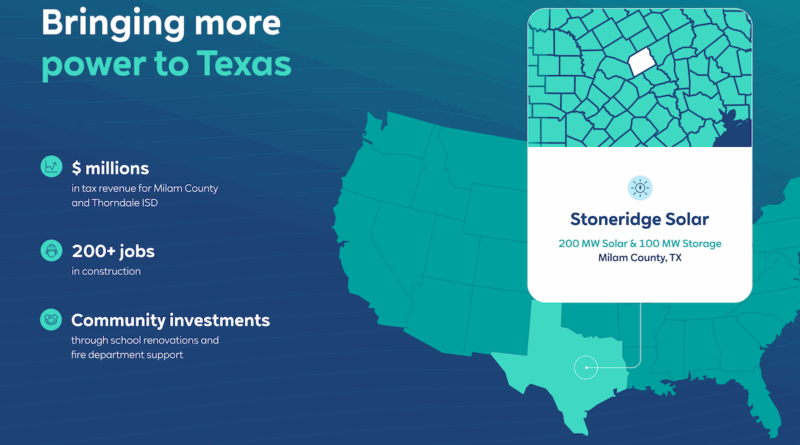
One interesting example comes from Texas, where the global energy firm RWE just flipped the switch on its new Stoneridge Solar power plant. The facility is located in Milam County, which bills itself as a “peaceful retreat” between Austin and Waco.
The new power plant includes a 200 megawatt-hour battery energy storage system along with a solar capacity of 200 megawatts, adding another notch to RWE’s 11-gigawatt footprint in in the US. “The project is expected to generate millions in tax revenue for Milam County and the Thorndale Independent School District, with direct investments supporting first responders and educational initiatives,” RWE notes. The non-revenue assist to Milam County schools includes funds for renovating a local elementary school.
Like all school districts in Texas, Milam County faces pressure from rising costs and stagnating assistance from state policymakers. A years-long bottleneck in state funding finally broke last summer, but the bulk of the new $85 billion funding went to increase teacher pay among the state’s 1,200 school systems, not to help offset rising operational costs. The new funds also failed to make a meaningful improvement in the all important metric of per-student allotment. Lawmakers did, however, approve a new $1 billion voucher program for non-public schools, a pet project of Texas Governor Greg Abbott.
Urban Solar Power: 20 Megawatts & Counting
Large, utility-scale solar power plants are beyond the immediate reach of urban school districts, but even a modest rooftop array can provide significant economic and educational benefits. For big cities with numerous schools, the numbers add up.
In October, the education news organization Chalkbeat New York took stock of New York City’s school solar program. “With solar panels on 126 school building rooftops, New York City schools are central to the city and state’s green energy goals and generate the majority of solar energy installed on municipal buildings,” observed reporter Seyma Bayram.
All together, the rooftop arrays have a capacity of almost 20 megawatts, accounting for about 80% of the combined rooftop capacity of all municipal properties in the city.
In addition to the economic and climate action benefits of school solar power, Bayram also teased out yet another significant reason to install rooftop solar at public schools. “More than half of FEMA’s approximately 67,500 designated shelters nationwide are located in schools, making it more urgent to equip them with solar storage systems that can provide backup power during outages,” Bayram explained.
Bayram also cites Sara Ross, whose nonprofit UndauntedK12 advocates for clean energy in schools. “ School budgets are tight, and fundamentally, solar is the cheapest energy around, so when schools install solar, they can reduce their operating costs,” Ross told Chalkbeat. “That frees up more dollars to go back into their core mission.”
Solar can also be a revenue earner in some cases. When school buildings are idle for holidays, their electricity needs are lower, and they can sell unused solar power back to the grid.
On the down side, as part of the fallout from the Republicans’ new “OBBA” federal tax bill, the cost of installing school solar arrays is expected to shoot up by as much as 30% after the end of 2027, when the relevant tax credits are set to expire. New country-of-origin restrictions on solar panels and other equipment could also put a crimp in the school solar movement.
Nevertheless, New York City is not letting the solar power grass grow under its feet. According to Bayram, 90 additional school solar projects are already in motion and 200 more are in the review process.
K–12 Schools As Solar Ambassadors
Despite their radically different political profiles, Texas and New York State are both hotspots for solar development among other renewable energy activities. West Virginia provides another perspective on the school solar movement, considering its longstanding hostility to anything that interferes with fossil energy extraction.
Talk of converting West Virginia’s spent coal mines to solar farms goes back at least as far as 2011, with little to show for it. As of 2020, West Virginia hit the lowly #49 slot in a state-by-state ranking of installed solar capacity, at just 10.52 megawatts. Still, a trickle of new utility-scale power plants benefiting school districts continued to slip through, and the emerging Energy-as-a-Service industry has added another wrinkle.
EaaS contracts enable the client to install new energy efficient systems and equipment without paying upfront costs. They pay off the installer in increments from their savings on energy costs, and pocket the rest for themselves. In some cases, those funds can help support new rooftop solar projects.
Last year, the CMTA branch of the advanced engineering consulting firm Legence recapped its EaaS work with the Grant County, West Virginia school district. The contract included guaranteed energy savings at all four schools in the rural district. One highlight was Petersburg Elementary School, where CMTA focused its “Zero Energy” strategy for introducing renewable energy supported by energy efficiency upgrades.
“The building was not Zero Energy ready prior to this project,” CMTA explained. “The elementary facility had a unique opportunity to have a large solar array installed that would be fully funded by energy savings.”
Power purchase agreements (PPA) are another financial tool aiding the school solar movement in West Virginia. In 2021, state lawmakers approved new legislation enabling schools to use PPA contracts. Among the first to set the wheels in motion was Calhoun County, which entered into a PPA for two of its schools with the firm Secure Solar Futures.
The two projects went live in May of this year. Got Electric, the company that installed the solar arrays, calculates that solar power is offsetting a healthy 70–80% of electricity used by the schools. At that rate, Secure Solar estimates that the school system will save $740,000 over the 25-year term of the agreement.
The Calhoun County project also illustrates the ripple effect of hands-on solar education at schools, with local students now getting a leg up on solar-related scholarships and apprenticeships as well as new job opportunities in their communities.
Who could hate it? West Virginia State Senator Craig Hart (R-Mingo), for one. Earlier this year, Hart proposed new legislation that would pull the rug out from under PPA contracts. “I don’t think a school is a good place to make a political statement about your utilities and whatnot,” Hart reportedly said during a committee meeting in April, while drawing politics into the conversation.
If you have any thoughts about that, drop a note in the comment thread.
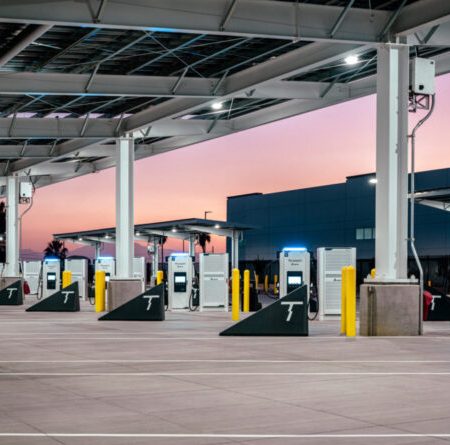
Image: Utility-scale solar power plants and rooftop solar installations are providing public schools in Texas and elsewhere across the country with relief from high electricity costs, while bringing new educational and workforce development opportunities into the classroom … who could hate it? Image courtesy of RWE (cropped).
This post first appeared on cleantechnica.com
Other Articles

The Strange Time Compression of Sodium-Ion Battery Development